
How to reduce LLM costs in a startup: a fractional CTO playbook to cut spend without breaking the product
A practical framework to reduce OpenAI, Anthropic, or Mistral spend in startups through usage audits, prompt trimming, routing, caching, and ROI-based governance.
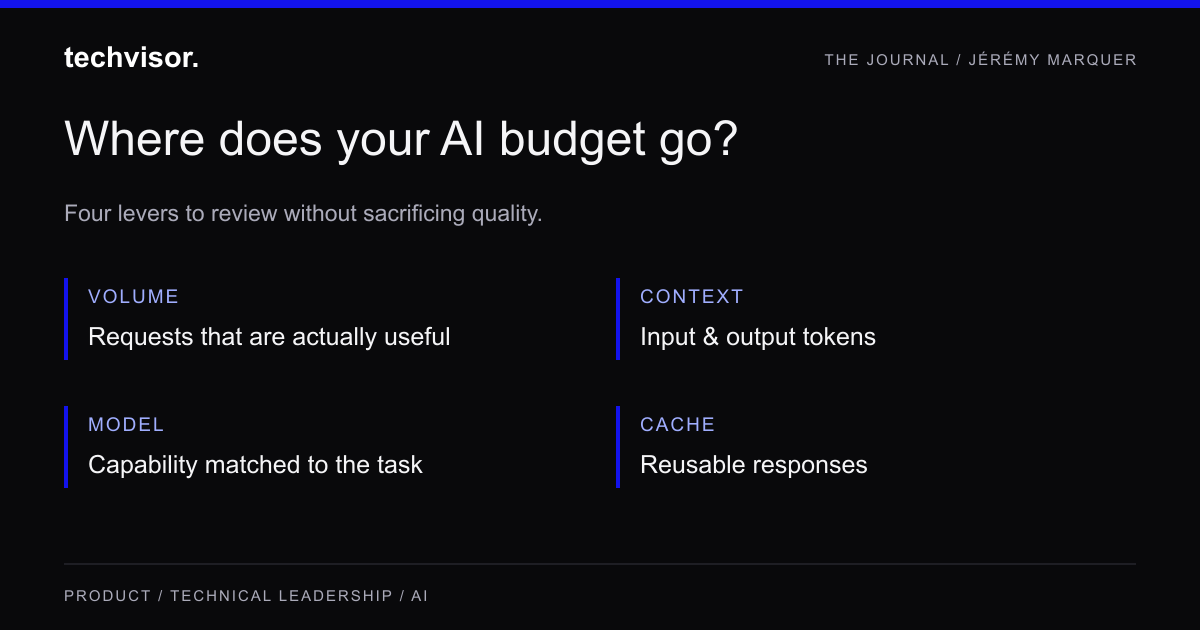
How to reduce LLM costs in a startup: a fractional CTO playbook to cut spend without breaking the product
There is a very predictable moment in AI-enabled startups.
At first, everyone is thrilled because the feature works. Then the API bill lands, margins start sweating, and someone in leadership says the line every team eventually hears: “We love the feature, but we cannot scale this economics.”
The problem is rarely that “AI is too expensive.” The real issue is that many teams ship LLM workflows without treating them like production systems.
That usually means:
- oversized models used everywhere,
- too many unnecessary tokens sent on every request,
- no distinction between high-value and low-value AI tasks,
- weak visibility into cost per user action,
- and very little connection between model quality and business ROI.
The good news: in a lot of startup environments, you can reduce 20% to 60% of LLM spend without materially hurting user experience. Sometimes more.
Not with a miracle. With discipline.
This is exactly where a fractional CTO can be useful: fast audit, architecture cleanup, cost guardrails, and execution without freezing product delivery for two months.
The warning signs your LLM stack is already becoming expensive in the wrong way
You do not need to wait for a finance crisis. The signals usually show up early.
The most common ones are:
- AI spend grows faster than customer usage
- Nobody can explain the cost of a single user workflow
- The same premium model is used for everything
- No caching, no fallback, no prompt discipline
- Prompts get larger every sprint
- Product tracks quality but not profitability
- Latency worsens at peak traffic because inference is bloated
If three or four of these sound familiar, this is no longer just an API choice problem. It is a technical governance problem.
Why LLM costs drift so fast
Startups do not fail here because they picked OpenAI, Anthropic, or another provider.
They fail because they treat the AI layer like a magical black box instead of a production capability that needs architecture, measurement, and operating rules.
The root causes I see most often are the following.
1) The wrong model tier for the job
A lot of teams connect one large model to every workflow: generation, classification, extraction, rewriting, support, scoring, summarization, all of it.
That is great for shipping quickly. It is also a beautiful way to destroy unit economics.
Simple tasks such as intent routing, document tagging, or structured extraction often do not need the most expensive model in the portfolio.
2) Obese prompts
It is very common to see prompts carrying:
- pages of system instructions,
- long conversation history that is no longer useful,
- poorly ranked RAG chunks,
- redundant JSON context,
- repeated examples the model no longer needs.
In other words, the company is paying tokens for dead weight.
3) No routing intelligence
The right pattern is not “one model for all use cases.”
The right pattern is:
- cheaper default path,
- escalation only when needed,
- clean fallback logic,
- explicit business rules per use case.
4) No feature-level cost ownership
If there is no cost view by use case, product feature, or customer segment, nobody can make rational trade-offs.
A feature can be well liked and still be economically toxic.
5) Quality is discussed separately from business value
An answer can be technically impressive and still not improve conversion, retention, internal productivity, or support efficiency.
That is not strategy. That is expensive theater.
A 5-step fractional CTO playbook to regain control
When I work on this kind of problem, I do not start by asking, “Which provider should we switch to?”
I start by making the spend legible. Otherwise, the team is optimizing in the dark.
Step 1 — Measure cost at the user-workflow level
The first job is to attach cost to something leadership actually understands.
For example:
- cost per generated summary,
- cost per support ticket handled,
- cost per analyzed document,
- cost per enriched lead,
- cost per monthly active user.
As long as the company only sees one monthly provider bill, decision-making stays fuzzy.
Minimum useful instrumentation:
- request count by feature,
- input tokens and output tokens,
- latency,
- failure rate,
- average unit cost,
- expected business impact.
Without that baseline, everything else is guesswork.
Step 2 — Segment use cases by business criticality
Not every AI task deserves the same budget or intelligence level.
A simple model I like is a 3-tier classification:
- Tier A — Business differentiator: AI quality clearly influences conversion, retention, or perceived value.
- Tier B — Important but standardizable: summaries, extraction, guided drafting, internal assistant workflows.
- Tier C — Convenience layer: repetitive, low-stakes, or back-office tasks.
Then each tier gets:
- a default model,
- a cost ceiling,
- an acceptable latency target,
- a fallback path if premium quality is not justified.
This is not revolutionary. It is just surprisingly rare.
Step 3 — Trim prompts and context aggressively
This is often the fastest high-ROI win.
You remove:
- redundant instructions,
- stale conversation history,
- weakly ranked RAG chunks,
- verbose output requests when short structured answers are enough,
- application fields that could be reconstructed outside the model call.
In some products, this alone reduces spend by 15% to 30%.
And yes, if your RAG layer sends 12 chunks to every request “just to be safe,” it is not actually being safe. It is simply taxing your gross margin. The AI layer deserves the same rigor as a production AI architecture and GDPR audit or a broader technical debt audit.
Step 4 — Add routing, caching, and guardrails
This is where the architecture starts earning its salary.
Three levers matter most.
Model routing
- cheaper model by default,
- stronger model only for higher-complexity or higher-stakes cases,
- escalation based on confidence, business rules, or structured evaluation.
Smart caching
- semantic cache for repeated questions,
- reuse of stable outputs,
- memoization of recurring enrichment or classification tasks.
Product guardrails
- output length limits,
- quota by workspace or user,
- abnormal usage alerts,
- graceful degraded mode when cost or latency spikes.
If you already think seriously about cloud infrastructure cost optimization for startups, your AI layer should be governed with the same seriousness.
Step 5 — Use ROI, not model prestige, to make decisions
The core question is not “Which is the smartest model?”
It is: What quality level is economically justified for this workflow?
Some very practical examples:
- if a model that is half the cost preserves 95% of perceived quality, that is usually the obvious choice;
- if premium quality clearly improves conversion in a revenue-critical flow, the added spend may be absolutely worth it;
- if an internal workflow can be semi-automated rather than fully generative, that is often the better operating decision.
One reason founders bring in a fractional CTO is precisely to make those trade-offs without stack religion or internal politics.
What a serious LLM cost audit should deliver
A proper audit should not end with 40 soft slides and no decisions.
It should produce an actionable roadmap.
Useful outputs include:
- map of AI workflows and providers,
- cost by user journey, feature, and customer segment,
- top 10 waste drivers,
- quick wins for the next 30 days,
- target routing and fallback architecture,
- effort/impact-prioritized backlog,
- monthly KPI dashboard for leadership.
That roadmap then needs to connect with broader startup tech strategy planning, not die quietly in Notion.
Simplified field example
B2B SaaS startup, 9-person team, AI module sold as a commercial differentiator.
Starting point:
- one premium model used everywhere,
- oversized conversation history,
- no caching layer,
- prompts enriched sprint after sprint with no cleanup,
- monthly AI spend growing by 18% month over month,
- CEO unable to tell whether the feature was profitable.
Four-week intervention:
- cost instrumentation by use case,
- context reduction,
- two-level model routing,
- cache on repetitive tasks,
- quotas and account-level observability.
Outcome:
- roughly 37% reduction in monthly spend,
- lower latency on frequent workflows,
- restored margin on a feature that was becoming dangerous,
- leadership discussion shifted from “Should we cut AI?” to “Where should we keep premium quality?”
That is the real goal: protect the value, kill the waste.
Mistakes that sabotage optimization
“We just need a cheaper provider”
Sometimes useful. Usually incomplete. Bad architecture stays bad architecture.
“Let’s reduce quality everywhere”
Classic panic move. Segment first. Cut with precision.
“Product can decide this alone”
Product sees usage. Engineering sees cost. Finance sees margin. All three matter.
“We’ll optimize later when volume is bigger”
That is how bad habits become embedded infrastructure.
When a fractional CTO becomes the right lever
You do not necessarily need a full-time CTO to solve this.
You do need a focused fractional CTO engagement for AI and product execution, and someone who can:
- connect product, finance, and architecture in the same conversation,
- run a fast and credible audit,
- align the team on useful metrics,
- make trade-offs between perceived quality, margin, and delivery speed,
- turn the topic into a concrete execution plan.
If your AI stack is getting expensive, the worst move is six weeks of random micro-optimizations with no system view. This is exactly the kind of project where a short, senior intervention can save months.
Final takeaway
Reducing LLM costs is not just an infrastructure topic.
It is a product design, application architecture, observability, governance, and unit economics topic.
Handled properly, you can keep the “wow” effect for users and restore healthy economics.
If useful, I can help you run a 30-minute AI stack diagnostic to identify the most likely cost leaks and the highest-leverage fixes.
French version: Réduire les coûts LLM d’une startup : le playbook CTO freelance
References
Related articles
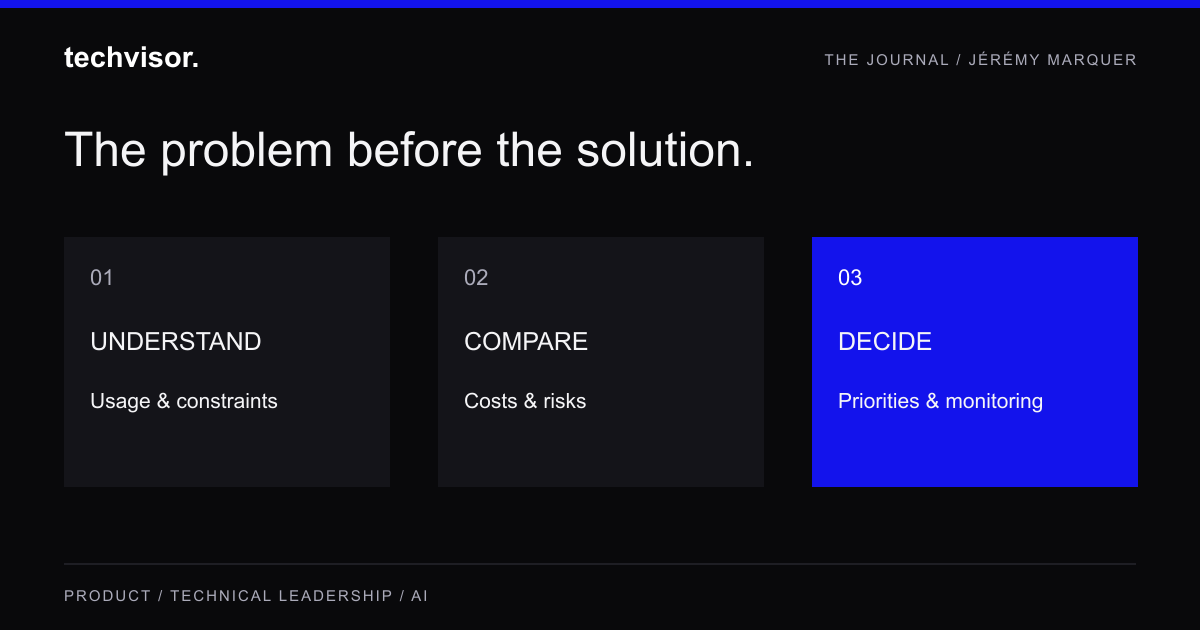
AI Production Architecture Audit: The 45-Day Plan to Reduce Risk, Cost, and Delivery Chaos
A practical framework for startup and SME leaders to audit AI systems in production: governance, GDPR, reliability, security, and unit economics.
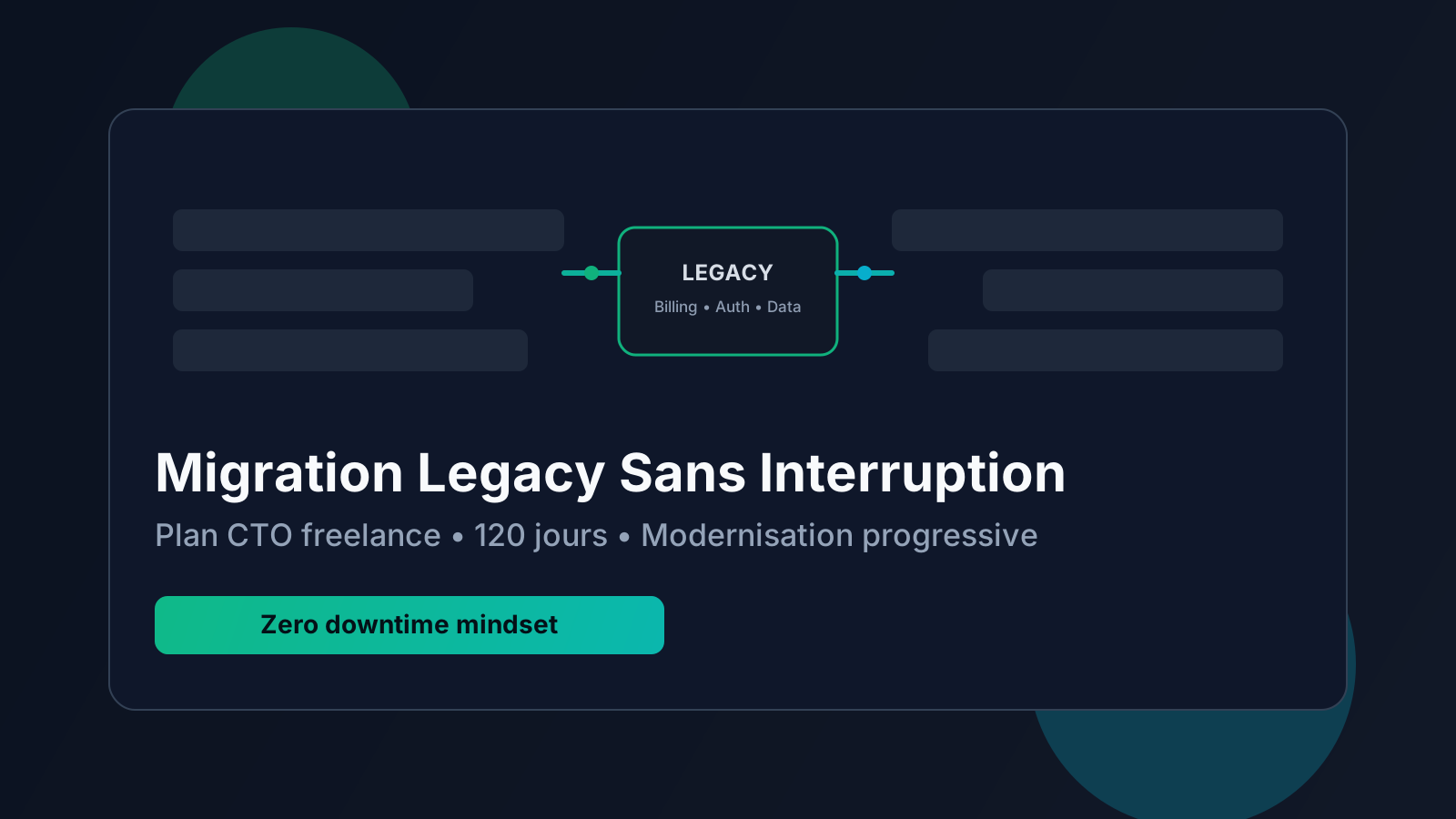
Legacy migration without downtime: a 120-day fractional CTO plan
How to modernize a legacy system without disrupting operations: architecture audit, phased migration strategy, risk governance, and a practical 120-day execution model.
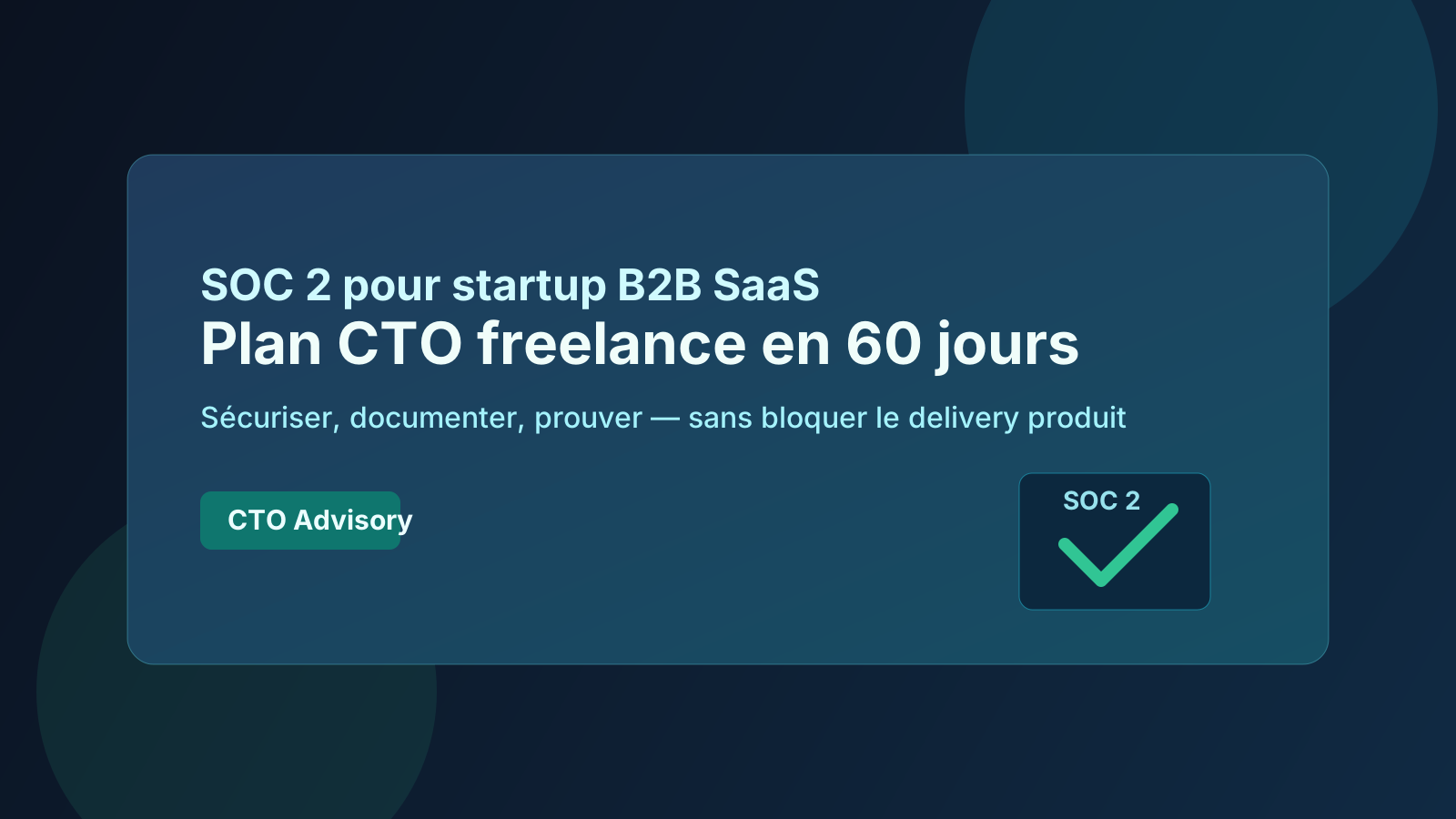
SOC 2 readiness for B2B SaaS startups: a 60-day fractional CTO plan
A practical framework to get SOC 2 audit-ready without killing product velocity: scope, controls, evidence, and governance led by a fractional CTO.