
SOC 2 readiness for B2B SaaS startups: a 60-day fractional CTO plan
A practical framework to get SOC 2 audit-ready without killing product velocity: scope, controls, evidence, and governance led by a fractional CTO.
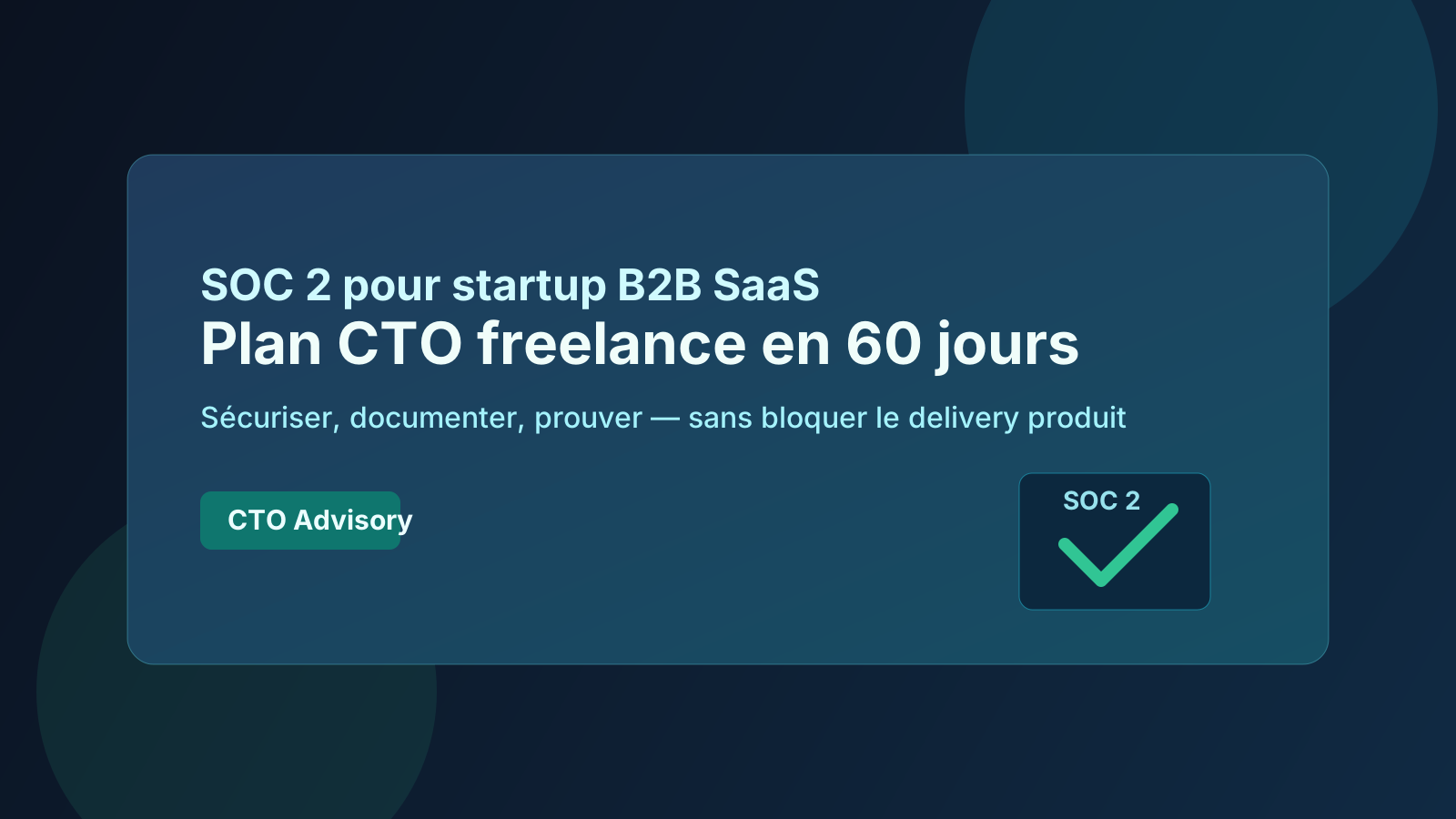
SOC 2 readiness for B2B SaaS startups: a 60-day fractional CTO plan
For early-stage and growth-stage B2B SaaS companies, SOC 2 usually becomes urgent at the worst possible moment:
- a high-value prospect is close to signing,
- procurement sends a long security questionnaire,
- legal asks for stronger controls,
- and the deal slows down because trust is not yet “provable.”
At that point, most teams treat SOC 2 as a documentation project.
That is exactly why they lose speed, burn engineering time, and still fail to build buyer confidence.
The better model is to treat SOC 2 as an operating-system upgrade for your company: technical controls, governance, and evidence discipline aligned with business outcomes.
This is where a fractional CTO is often the fastest way to execution.
What buyers actually care about (beyond the SOC 2 label)
Enterprise buyers are not purchasing your certificate. They are purchasing risk confidence.
They want to see that you can:
- control who has access to critical systems,
- ship changes safely,
- detect and handle incidents,
- maintain reliable evidence over time,
- run clear ownership and accountability.
SOC 2 is simply the framework used to validate those capabilities.
That is why “we have a policy doc” is never enough.
Why SOC 2 initiatives stall in startups
Across engagements, the same failure patterns appear repeatedly.
1) Compliance is run as a side project
Security work competes with product commitments instead of being integrated into delivery planning.
2) Tool-first strategy, ownership-second
A compliance platform can help, but it cannot replace clear owners, recurring rituals, and execution discipline.
3) Everything becomes top priority
Access reviews, incident process, vendor management, policy writing, backup testing, HR controls—all started at once. Nothing closes properly.
4) Evidence is left for “later”
Teams implement controls but forget to structure recurring proof collection. Audit prep becomes chaotic.
5) Leadership alignment is weak
Without CEO/COO/Product alignment, engineering carries trade-offs alone and loses momentum.
Why a fractional CTO is a high-leverage setup
In this context, a fractional CTO provides immediate leverage by connecting business urgency and technical execution.
Core value:
- turn SOC 2 into a realistic delivery plan,
- sequence controls by business impact and risk,
- protect product velocity while improving security posture,
- prepare durable ownership after the engagement.
This is especially useful when:
- there is no full-time CTO yet,
- the current CTO is overloaded with product and team scaling,
- enterprise sales pressure requires fast, credible progress.
A practical 60-day execution plan
Below is a field-tested structure you can adapt.
Phase 1 (Days 1–10): scope, business intent, and gap baseline
Goal: define a credible path and avoid “checkbox theater.”
Key actions:
- define systems/products in scope,
- choose Type I vs Type II target based on sales timeline,
- map critical data flows and privileged access points,
- assess gaps on priority control domains,
- set ownership and weekly governance.
Outputs:
- 30/60/90-day readiness roadmap,
- risk register tied to customer and operational impact,
- RACI model for decisions and execution.
Phase 2 (Days 11–35): implement foundational controls
Focus first on controls that reduce large risk with manageable implementation effort.
Common priorities:
-
Identity and access management
- MFA enforcement,
- dormant account cleanup,
- periodic access review process.
-
Change management discipline
- mandatory peer review,
- environment separation,
- deployment traceability and rollback practice.
-
Incident response maturity
- usable alerting,
- clear runbooks,
- consistent post-incident reviews.
-
Critical vendor governance
- vendor inventory,
- risk tiering,
- minimum evidence of due diligence.
-
Lean but active policies
- access, security, change, continuity,
- versioned, understandable, and enforceable.
The principle: implement what the team can sustain after external support ends.
Phase 3 (Days 36–60): evidence hardening and audit readiness
Most delays happen here because evidence management was underestimated.
Execution focus:
- move from ad-hoc artifacts to recurring evidence collection,
- run internal control walkthroughs (mini-audit simulations),
- close execution/documentation mismatches,
- prepare consistent security responses for sales and procurement.
This is also where SOC 2 readiness supports go-to-market directly:
- sales can answer security objections faster,
- legal review cycles shorten,
- buyer confidence increases with concrete proof.
KPIs to track so compliance does not kill velocity
Use a small set of practical indicators:
- percentage of priority controls operating effectively,
- time to revoke access after offboarding,
- share of production changes with complete traceability,
- mean time to detect and resolve incidents,
- evidence completeness per control domain,
- delivery throughput impact over the period.
If compliance progress rises while delivery collapses, the operating model is broken.
Real-world example (anonymized)
B2B SaaS company, 28 employees, moving upmarket.
Starting point:
- two enterprise opportunities (>€120k ARR each) blocked by security review,
- generic security docs with low real adoption,
- over-privileged cloud access across several users,
- no stable access review rhythm.
8-week intervention:
- readiness scope and control prioritization,
- IAM remediation and stronger change process,
- incident runbooks and postmortem structure,
- evidence workflow + standardized security FAQ for sales.
Outcomes:
- faster turnaround on questionnaires,
- fewer back-and-forth loops with procurement,
- stronger trust signals for enterprise buyers,
- lower operational risk with clearer ownership.
The impact was not just “audit readiness.” It was better execution and better commercial credibility.
Is now the right time for SOC 2?
Not for every startup. But timing is usually right when:
- security objections are slowing enterprise deals,
- teams answer each customer request from scratch,
- your process maturity lags your revenue ambitions,
- you need structure before hiring a full-time CTO/CISO profile.
Architecture choices that make or break readiness
Many teams assume SOC 2 is mostly documentation. In reality, a few technical choices drive most audit friction.
Prioritize these early:
-
Scope boundaries
If “in-scope systems” are fuzzy, teams gather useless evidence while missing critical controls. -
Secrets and privileged access strategy
Shared admin accounts, hardcoded credentials, or weak vault discipline quickly become audit pain points. -
Actionable logging and traceability
Logs are not enough; they must support real investigation, incident reconstruction, and change accountability.
This is where senior CTO judgment matters: enough rigor to reduce risk, enough pragmatism to preserve delivery speed.
90-day enterprise-deal readiness checklist
If your immediate goal is to unblock enterprise contracts, start with a focused baseline:
- MFA and recurring review for privileged accounts,
- a real, used change-management flow,
- tested incident runbook and post-incident tracking,
- critical vendor inventory with risk tiering,
- a reusable security answer kit for sales/procurement.
This won’t replace full SOC 2 maturity, but it drastically improves trust signals in active deal cycles.
Final takeaway
SOC 2 becomes expensive when treated as paperwork.
It becomes strategic when run as a focused operational transformation:
- business-aligned,
- risk-prioritized,
- evidence-driven,
- and execution-friendly for product teams.
If helpful, I can review your current setup and map a practical SOC 2 readiness plan in one working session.
Related articles
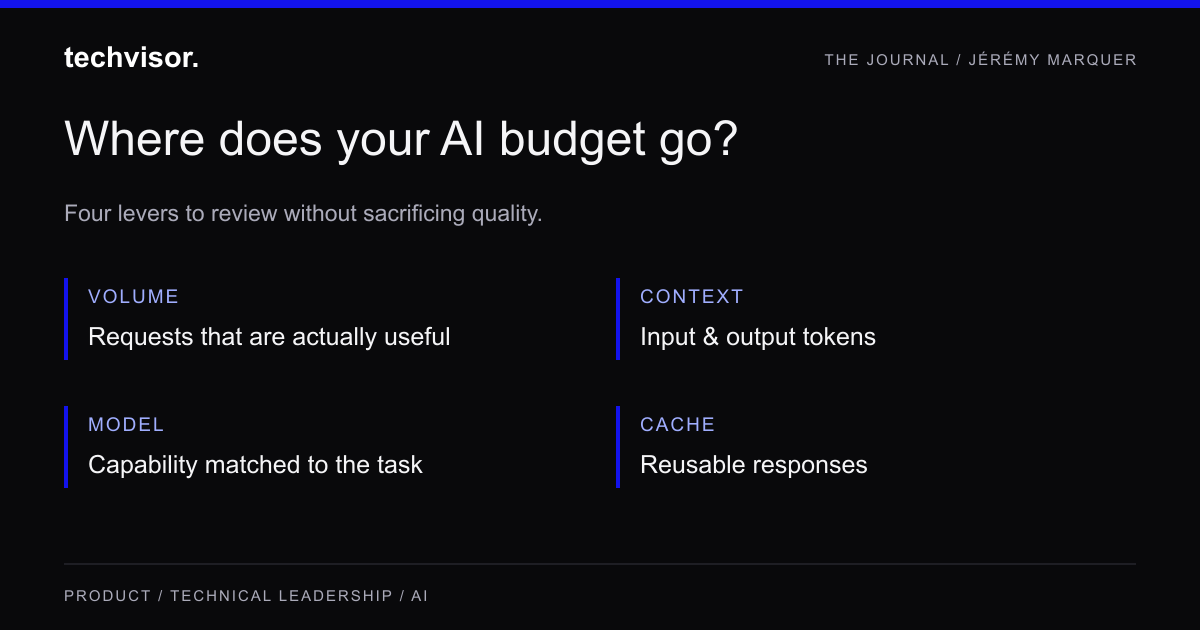
How to reduce LLM costs in a startup: a fractional CTO playbook to cut spend without breaking the product
A practical framework to reduce OpenAI, Anthropic, or Mistral spend in startups through usage audits, prompt trimming, routing, caching, and ROI-based governance.
AI Production Architecture Audit: The 45-Day Plan to Reduce Risk, Cost, and Delivery Chaos
A practical framework for startup and SME leaders to audit AI systems in production: governance, GDPR, reliability, security, and unit economics.
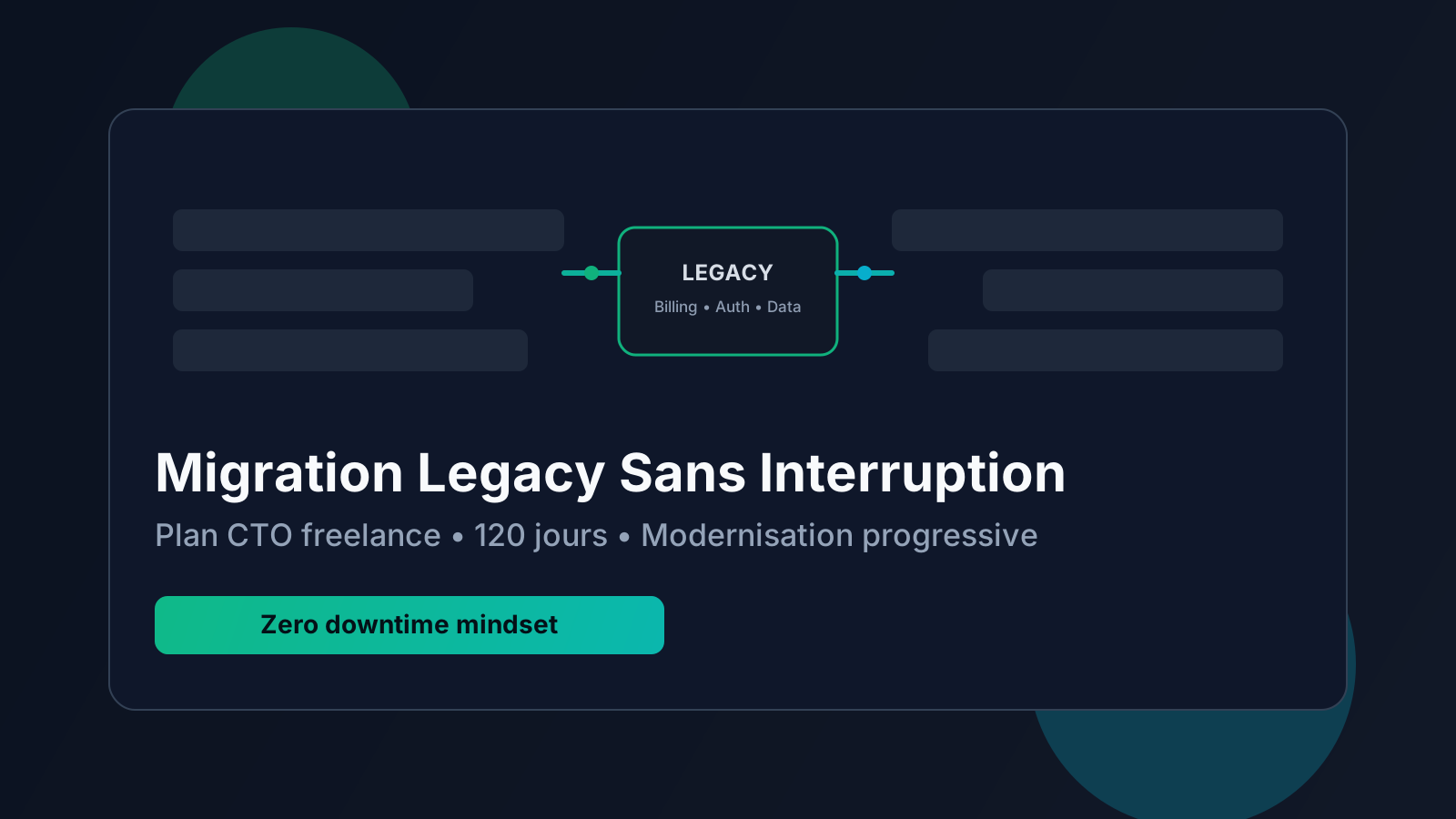
Legacy migration without downtime: a 120-day fractional CTO plan
How to modernize a legacy system without disrupting operations: architecture audit, phased migration strategy, risk governance, and a practical 120-day execution model.