
AI Production Architecture Audit: The 45-Day Plan to Reduce Risk, Cost, and Delivery Chaos
A practical framework for startup and SME leaders to audit AI systems in production: governance, GDPR, reliability, security, and unit economics.
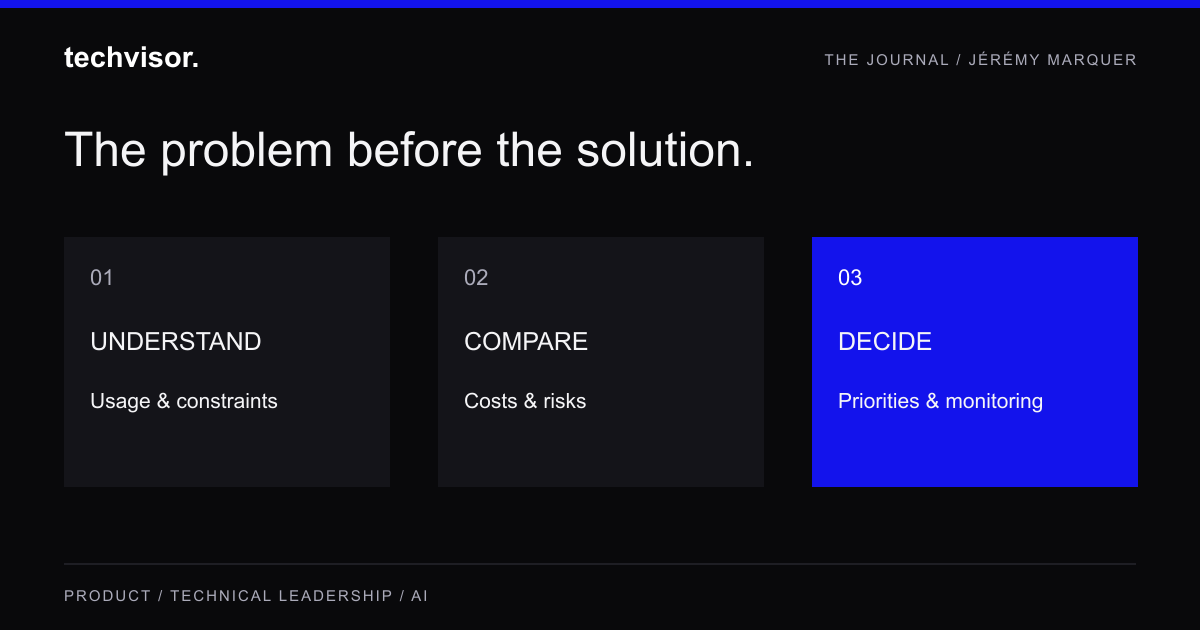
AI Production Architecture Audit: The 45-Day Plan to Reduce Risk, Cost, and Delivery Chaos
Most companies already have “AI in production.” But when you inspect the system, the same pattern appears:
- prompts changed directly in code with no governance,
- rising model costs with poor visibility,
- sensitive data flowing through tools without clear controls,
- unstable quality (hallucinations, latency spikes, inconsistent outputs),
- and no clear owner balancing speed vs compliance.
The question is no longer whether to use AI. The real question is: can your company operate AI reliably, profitably, and compliantly?
If you are a founder, CEO, COO, or product leader, this guide gives you a practical 45-day framework to audit your AI architecture and regain control.
French version: Audit architecture IA en production
Why this is a business topic (not just an engineering topic)
An AI architecture audit protects revenue and valuation, not only infrastructure quality.
It addresses four direct business risks:
- Financial risk: AI spend grows faster than business value.
- Legal risk: personal/sensitive data processing is not demonstrably controlled.
- Commercial risk: unreliable AI output damages trust and conversion.
- Execution risk: teams get trapped in recurring AI incidents.
This is a common turning point in Fractional CTO engagements: the use case is validated, but the operating system around it is not.
Signals that you should run an audit now
If two or more of the following are true, move this up your priority list:
- AI API costs doubled in a quarter with no clear ROI narrative.
- No one can document exactly what data is sent to which provider.
- Prompt/response logs have no clear retention or deletion policy.
- AI incidents are handled ad hoc with no postmortem discipline.
- Support receives increasing “wrong answer” or “off-policy output” complaints.
- Enterprise prospects ask compliance/security questions your team cannot answer clearly.
Before scaling AI delivery, stabilize the foundation.
The 6-pillar AI audit framework
1) Data flow mapping
Start with one essential question: what data enters, exits, and persists across the AI stack?
Map:
- data sources (CRM, support tickets, internal docs, product analytics),
- sensitivity classes (PII, contractual data, regulated fields),
- destinations (model provider, vector database, app logs),
- retention windows,
- legal basis and minimization controls.
Without this map, compliance discussions remain theoretical.
Reference: European Commission GDPR portal.
2) Prompt, model, and version governance
Critical AI behavior often changes without structured review.
Minimum governance baseline:
- version prompts and model parameters,
- require approval path before production changes,
- track model/provider per feature,
- keep a visible changelog for customer-impacting modifications.
Think of this like release management, not experimentation theater.
If your delivery is already unstable, this pairs well with a 90-day startup delivery recovery plan.
3) Output reliability and guardrails
A good AI system is not the one that demos well. It is the one that behaves acceptably under real operational pressure.
Practical controls:
- define business-grounded test suites,
- monitor error and human-escalation rates,
- design confidence-based fallback behavior,
- prevent high-impact autonomous actions without human checks.
This discipline is close to how mature teams run a startup production incident postmortem framework.
4) Security and GDPR controls that are actually operable
Compliance should be executable, not decorative.
Implement:
- data minimization before model calls,
- masking/pseudonymization of sensitive fields,
- explicit retention/deletion rules,
- provider and subprocessors register,
- contractual controls aligned with real data flows.
Legal text reference: Regulation (EU) 2016/679 – GDPR.
5) AI unit economics
Do not optimize “cost per token” in isolation. Optimize cost per business outcome.
Examples:
- cost per support case resolved,
- cost per summary delivered to product teams,
- cost per qualified lead enrichment,
- latency vs conversion impact,
- AI cost share vs revenue protected or created.
Use the same rigor you would apply to a cloud cost optimization strategy for startups.
6) Operating model and ownership
Many AI programs fail due to ambiguous ownership, not model quality.
Recommended structure:
- AI product owner: use-case prioritization and ROI,
- AI technical owner: reliability, architecture, observability,
- security/compliance owner: legal and risk sign-off,
- monthly governance review for incidents, spend, and roadmap decisions.
No clear owner means no durable progress.
A practical 45-day execution plan
Days 1–10: rapid assessment
Goal: establish baseline reality.
- inventory production AI use cases,
- map providers, data classes, and interfaces,
- baseline cost/latency/quality,
- rank top business and compliance risks.
Deliverable: AI risk/value scorecard.
Days 11–25: secure the fundamentals
Goal: reduce major exposure quickly.
- data minimization and masking,
- retention/deletion policy implementation,
- prompt and model change governance,
- guardrails for high-impact workflows,
- incident runbook for AI failures.
Deliverable: operational control baseline.
Days 26–45: scale with governance
Goal: make AI operations decision-grade.
- dashboard for cost/quality/reliability,
- monthly governance cadence,
- make-vs-buy decisions per capability,
- 90-day roadmap aligned with business KPIs.
Deliverable: cross-functional execution roadmap.
Common mistakes to avoid
- Treating production AI like an endless PoC.
- Measuring quality without measuring cost and latency.
- Underestimating compliance until enterprise sales asks hard questions.
- Multiplying providers without fallback and observability strategy.
- Keeping ownership implicit across product, engineering, and legal.
Where a Fractional CTO creates leverage
A strong external CTO profile is valuable when you need speed and control at once.
Typical outcomes:
- business-priority-first audit scope,
- risk reduction focused on sales/fundraising blockers,
- lightweight but enforceable governance model,
- conversion of AI debt into measurable execution steps.
Final takeaway
AI in production is not a model-only challenge. It is an operating-system challenge across data, reliability, compliance, cost, and governance.
The teams that win are not the ones shipping the most demos. They are the ones turning AI capability into a dependable business asset.
In one session, we can identify your top three AI production risks and convert them into a concrete 45-day action plan.
Related articles
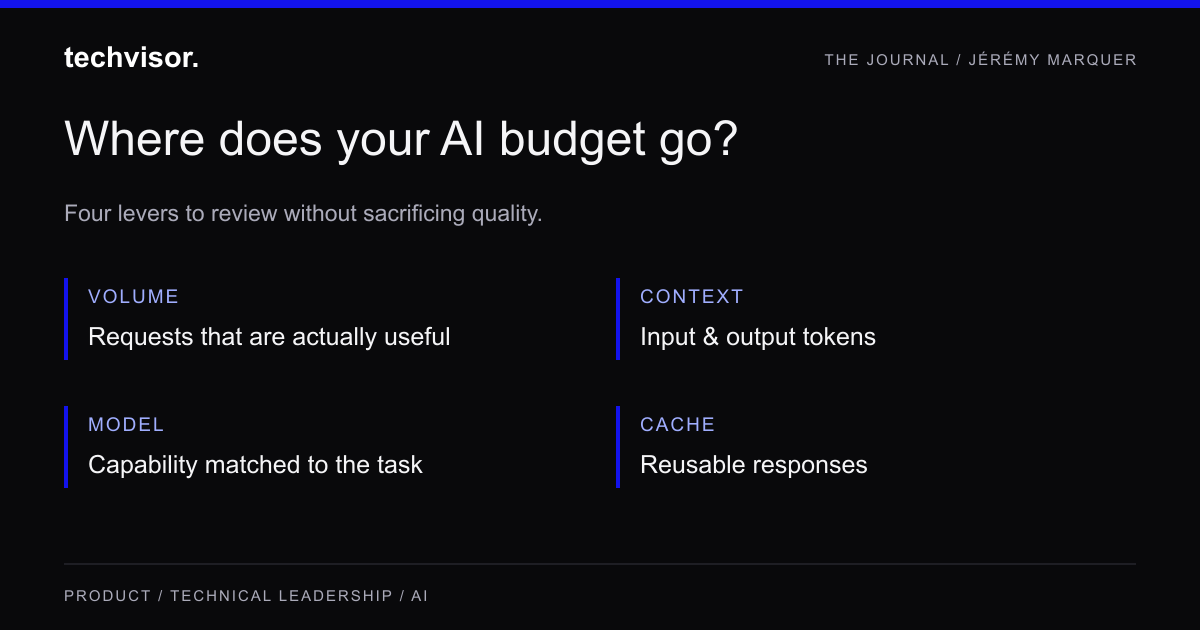
How to reduce LLM costs in a startup: a fractional CTO playbook to cut spend without breaking the product
A practical framework to reduce OpenAI, Anthropic, or Mistral spend in startups through usage audits, prompt trimming, routing, caching, and ROI-based governance.
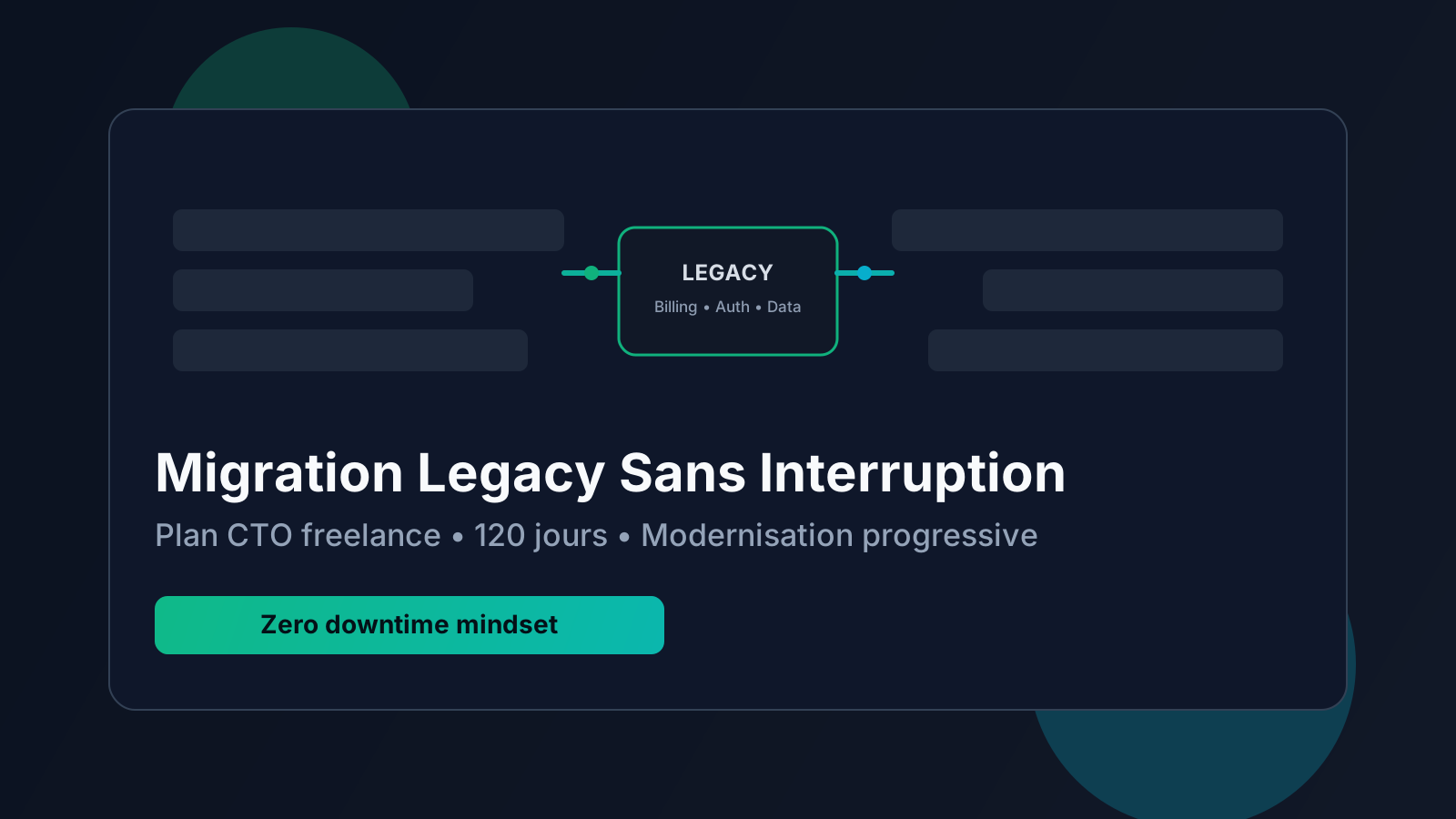
Legacy migration without downtime: a 120-day fractional CTO plan
How to modernize a legacy system without disrupting operations: architecture audit, phased migration strategy, risk governance, and a practical 120-day execution model.
SOC 2 readiness for B2B SaaS startups: a 60-day fractional CTO plan
A practical framework to get SOC 2 audit-ready without killing product velocity: scope, controls, evidence, and governance led by a fractional CTO.