
Startup delivery behind? A 90-day fractional CTO plan to get execution back on track
A practical 90-day framework to recover startup delivery: diagnose bottlenecks, align product and engineering, reduce incidents, and restore predictable execution.

Startup delivery behind? A 90-day fractional CTO plan to get execution back on track
Your team is busy. Sprints are running. Tickets are closed.
And yet, the business roadmap keeps slipping.
This is one of the most common patterns in startups and SMB tech companies:
- founders feel execution is slower than expected,
- product pushes for market deadlines,
- engineering says capacity is maxed out,
- nobody can clearly explain where delivery speed is actually lost.
In most cases, the issue is not a lack of talent. It is a leadership and operating-system gap between business goals, product decisions, and engineering execution.
That is where a fractional CTO can create immediate leverage: clarify decisions, reduce operational drag, and restore predictable delivery without rushing into a permanent executive hire.
Here is the 90-day framework I use in real engagements.
Early warning signs your delivery engine is drifting
If you recognize at least 4 of these signals, your delivery system needs intervention now.
-
Priorities shift every week
Commercial urgency constantly reshuffles the roadmap. -
Lead time keeps growing
The delay between decision and production keeps expanding. -
Critical dependency on 1–2 people
One absence can block delivery across teams. -
Technical debt is postponed until it becomes an incident
Reliability work is always deferred, then paid in production pain. -
Product vs engineering tension becomes structural
Product optimizes for speed, engineering for risk, with no robust arbitration. -
No visibility into run vs build capacity
Nobody can quantify how much time is consumed by bugs, support, and incidents. -
Leadership lacks forecast confidence
Updates are frequent, but predictability remains low.
At this stage, hiring more developers rarely solves the core issue. It can even increase coordination friction.
Why a fractional CTO is often the fastest fix
The default reaction is usually: “Let’s hire a full-time CTO now.”
That can be correct long-term, but in the short term it is often too slow and too risky.
A senior CTO search typically takes months. Meanwhile, the delivery system keeps degrading.
A fractional CTO gives you three immediate advantages:
- Fast activation: start in days, not quarters.
- Outcome-focused mandate: delivery, risk, governance, and alignment.
- Neutral arbitration: a credible bridge between founders, product, and engineering.
The objective is not to “replace” your team. The objective is to restore a high-functioning operating model and prepare the right long-term leadership setup.
The 90-day delivery recovery plan
Phase 1 (Days 1–15): operational diagnosis, not a slide deck audit
Goal: identify where throughput is lost using evidence, not assumptions.
Core actions:
- analyze flow from request to production,
- map bottlenecks (decision loops, QA, dependencies, CI/CD, architecture constraints),
- quantify run vs build capacity,
- review incidents from the last 90 days,
- run focused interviews with CEO/COO, Product, Engineering leaders.
Useful outputs:
- baseline scorecard (lead time, deploy frequency, P1/P2 incidents, unplanned work share),
- top 5 root causes behind roadmap slippage,
- prioritized action plan by impact and effort.
Common mistake: trying to fix everything at once.
Better approach: isolate the 20% of constraints creating 80% of the drag.
Phase 2 (Days 16–45): stabilize governance and execution rules
Many teams frame delivery issues as purely technical. In reality, governance is often the bigger blocker.
You re-establish simple but strict rules:
- Clear decision rights (architecture, quality gates, priorities, incidents)
- Weekly product-engineering arbitration ritual tied to business outcomes
- Single prioritization framework (Now / Next / Later with explicit criteria)
- Strong definition of Done (tests, monitoring, rollback path, essential docs)
At the same time, deliver high-ROI quick wins such as:
- removing CI/CD bottlenecks,
- hardening unstable integrations,
- reducing alert noise to improve incident response,
- tightening cloud and production access controls.
Expected result: less chaos and visibly better delivery cadence within 3–4 weeks.
Phase 3 (Days 46–90): accelerate without recreating debt
Once the system is stable, you can scale throughput safely.
What to implement:
- a 90-day roadmap aligned with real capacity,
- feature slicing into shippable increments,
- explicit dependency management across product, data, and ops,
- weekly KPI review in a delivery steering forum.
And critically, prepare the post-recovery model:
- Option A: hire a permanent CTO with a realistic, context-aware scope,
- Option B: elevate an internal engineering lead with structured support.
Recovery is durable only if execution can continue without heroics.
KPIs that matter (and those that mislead)
If you want real control over delivery recovery, use flow metrics, not activity metrics.
Metrics to track
- Average lead time by work type
- Deployment frequency
- P1/P2 incident rate
- MTTR (mean time to recovery)
- Share of capacity consumed by unplanned work
- Commitment reliability by delivery slice
Metrics to treat carefully
- Raw number of closed tickets
- Total “busy hours”
- Story point velocity without quality controls
The key question is simple: Can your team deliver business value predictably?
Field example (anonymized)
B2B SaaS, 16 employees, 7-person engineering team. Commercial roadmap delayed by five months.
Starting conditions:
- 42% of engineering capacity consumed by unplanned run work,
- production deployments every 2–3 weeks,
- recurring incidents on billing flows,
- heavy tension between Product and Engineering.
90-day intervention:
- reset priorities with a weekly product-tech steering cadence,
- stabilize billing flow and observability,
- standardize definition of Done,
- split large initiatives into incremental releases,
- coach internal lead engineer toward ownership.
By day 90:
- deployment frequency improved by 2.6x,
- critical incident pressure significantly reduced,
- lead time down by 34%,
- roadmap regained credibility with both team and board.
The breakthrough was not “working harder.” It was leading execution better.
Four mistakes that kill delivery recovery
- Starting a full platform rewrite too early
- Overpromising to reassure stakeholders
- Treating every urgent request as strategic priority
- Ignoring the human layer (ownership, trust, communication)
Delivery problems are always technical and organizational.
When to bring in a fractional CTO
The best moment is before delays become a customer or cash problem.
If this sounds familiar:
- your team is capable but misaligned,
- key business milestones are due in the next quarter,
- you do not yet have bandwidth for a full executive search,
- you need a structured recovery plan, not reactive firefighting,
…a fractional CTO engagement is often the fastest path back to control.
Final takeaway
Delivery drift is recoverable. But not through intuition alone.
You need:
- an actionable diagnosis,
- clear decision governance,
- targeted quick wins,
- disciplined 90-day execution,
- and a leadership path for what comes next.
If useful, I can run a 30-minute delivery diagnostic and pinpoint the top 2–3 levers with the highest impact for your context.
Related articles
Legacy migration without downtime: a 120-day fractional CTO plan
How to modernize a legacy system without disrupting operations: architecture audit, phased migration strategy, risk governance, and a practical 120-day execution model.
Technical debt audit for startups: a 30-day remediation plan that protects delivery
How to run a technical debt audit in a startup and execute a 30-day remediation plan without freezing product delivery.
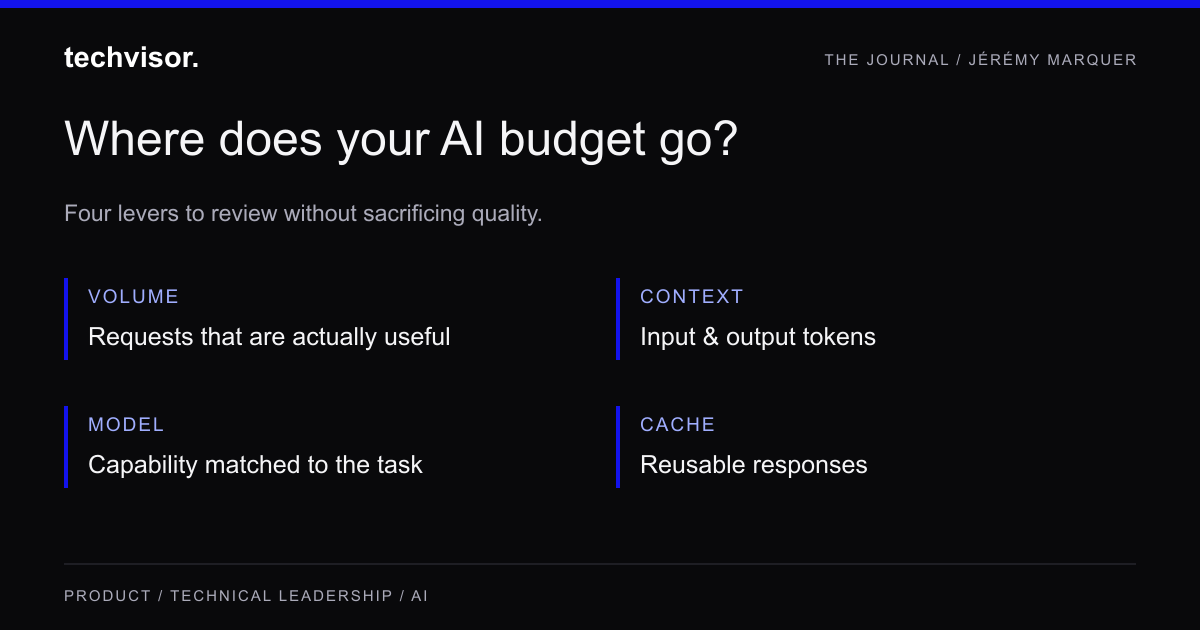
How to reduce LLM costs in a startup: a fractional CTO playbook to cut spend without breaking the product
A practical framework to reduce OpenAI, Anthropic, or Mistral spend in startups through usage audits, prompt trimming, routing, caching, and ROI-based governance.