
Data & AI governance playbook for scaling teams
A playbook for scale-ups to align data policy, AI risk decisions, and delivery before they grow from MVP to global product.
Data & AI governance playbook for scaling teams
Scaling from a high-performing MVP to a global product means your data estate and AI initiatives no longer live in a single spreadsheet. Without a governance framework, every new model, ingestion job or analytics experiment becomes a potential trigger for a compliance review, an unplanned outage or a sales pitch that misses its mark.
Governance is not about slowing things down. It gives you a shared language across product, engineering and leadership so you can release faster with confidence. That shared language should echo the strategy you already set in Startup Tech Strategy 2025: clarity on intent, clear prioritisation, and measurable outcomes.
Investors and partners love to see this documentation before they escalate a term sheet. Having a governance playbook is what lets you turn a product roadmap conversation into a confident delivery plan.
1. Why data & AI governance can’t wait
- Acceleration of data sources: data comes from product telemetry, customer conversations, partner feeds, and experimental automation. Without a single map, teams duplicate ingestion pipelines and miss critical dependencies.
- Regulators and investors need proof: frameworks like the NIST AI Risk Management Framework and the OECD AI Principles both ask for documented risk tiers and accountability, not just promises.
- Models now touch revenue: a recommendation engine, an automated pricing model or an agentic assistant can trip the same operational and reputational issues as a production incident. Governance is the defence layer between fast experiments and disastrous rollouts.
Capture this insight in a single risk register so you can show leadership exactly which initiatives are high risk and why. It also makes it easier to explain the scope to partners when you spin up a new pilot.
2. Map the data & AI value chain
Start with a diagram: ingestion sources, storage, models, APIs, dashboards, security wrappers. Overlay it with the responsible teams, the owners of the data contracts, and the guardrails for release. That same map helps you spot where technical debt sits — the obsolete scripts, the undocumented schemas and the manual handoffs.
Once you can point to the debt, you can prioritise a 30-day remediation sprint (see how we do it in Technical debt audit for startups) and backfill with the right engineers. You also gain the artifacts that show investors and buyers you know how to scale with discipline.
Pair the map with a product-risk matrix so each feature release carries a documented impact, rollout plan and rollback trigger. That matrix should travel with the governance artifacts whenever you bring a new stakeholder into the room.
3. Assign clear roles and a lean governance ritual
Governance is a ritual, not a bureaucratic inbox. Form a lightweight data council: a product sponsor, an ML engineer, a data engineer, a compliance partner and a fractional CTO who keeps the architecture honest. Define the RACI around data quality, deployment approvals, and incident response so nobody assumes someone else is owning the next release.
Schedule a short weekly slot (30 minutes) with three checkpoints: priority shifts, risk updates, and regulatory actions. Share decisions in a concise memo for stakeholders. Rotate the note-taker, publish the notes to your internal wiki and feed the action items back to delivery squads. These are the same deliverables that surface during a technical due diligence, where buyers want to see governance on paper, not just in people’s heads.
4. Make decisions with scoring and AI risk controls
For every AI initiative, evaluate it on three axes: outcome impact, risk exposure, and execution effort. Use that scoring to decide which pilots go to production first and which ones land in the backlog. Track the reasoning in a reusable decision template (business case + risk register).
NIST recommends logging the data lineage, testing results and control owners for each model, while OECD pushes for explainability and fairness checks. Embed those requirements directly into the governance template so every release includes a short checklist: data sources, guardrails, bias review, monitoring plan. When you do this consistently, you can defend each release internally and with external auditors.
Treat the template as a gate: if critical controls are missing, hold the release until the risk owner signs off, then log the decision in your governance workspace. This turns your governance playbook into a repeatable hand-off for any partner or regulator who wants to understand why a model went live.
5. Observe, respond, and document incidents
Operational governance shows up in dashboards, runbooks and retros. Any data incident (stale dataset, offline model, pipeline degradation) should trigger a mini post-mortem: what happened, how long did it impact customers, what immediate mitigation and what long-term fix.
Instrument observability across multi-cloud providers, normalize alerts, and publish a single incident timeline. Partner with SRE and security to keep the instrumentation alive even when teams rotate, and connect your alerts to an executive dashboard so the board sees progress. Link the learnings back to your product KPIs, and capture follow-up items in your governance workspace. You can borrow the rhythm of our Product incident postmortem framework and tailor it to AI and analytics incidents.
6. 90-day plan to lock governance and delivery
- Weeks 1-2 — Discovery: map your data estate, list risk tiers, interview product, engineering and legal stakeholders.
- Weeks 3-4 — Design: build the data council, create the RACI, put scoring templates in place and define KPIs.
- Weeks 5-7 — Execution: automate runbooks, update observability dashboards, roll out the first gated release process.
- Weeks 8-12 — Resilience: bake the reviews into storytelling, show the dashboards to leadership, and hand over the governance artifacts.
Along the way, circulate the artifacts with your core product or operations committee so the new guardrails become part of the normal sprint cadence. This keeps the governance playbook from bottlenecking the team and turns it into a shared toolkit.
Each phase ends with a tangible deliverable (impact map, decision digest, runbook, resilience report). That cadence reassures leadership and prepares you for the next growth inflection. If you prefer to accelerate with a specialist, let’s explore how a CTO freelance focused on AI can embed these practices without derailing delivery.
Let’s talk: Book a 30-minute diagnostic to align your governance workspace with your roadmap.
For the French version, check the Gouvernance data & IA pour scale-ups article that mirrors this playbook with a slightly different angle for local decision-makers.
Final word: Governance is not a legal bind, it’s the trust fabric that lets your teams move fast without dropping the compliance or reliability ball. In 90 days, you can replace opinions with documented decisions — and I can help you build the pattern.
Related articles
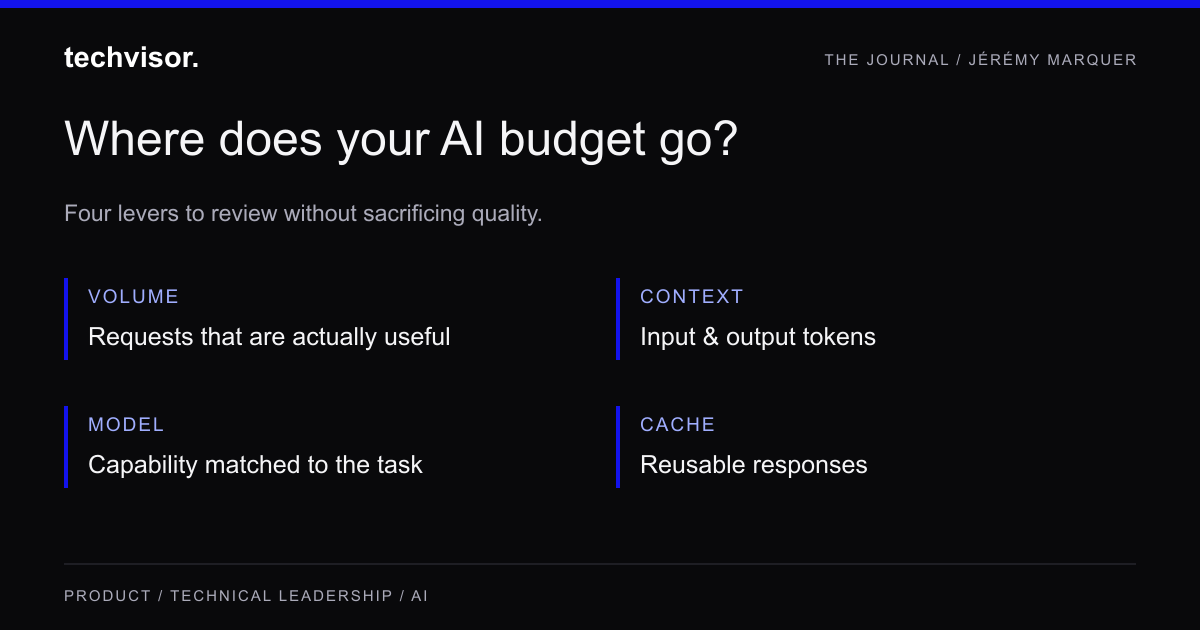
How to reduce LLM costs in a startup: a fractional CTO playbook to cut spend without breaking the product
A practical framework to reduce OpenAI, Anthropic, or Mistral spend in startups through usage audits, prompt trimming, routing, caching, and ROI-based governance.
AI Production Architecture Audit: The 45-Day Plan to Reduce Risk, Cost, and Delivery Chaos
A practical framework for startup and SME leaders to audit AI systems in production: governance, GDPR, reliability, security, and unit economics.
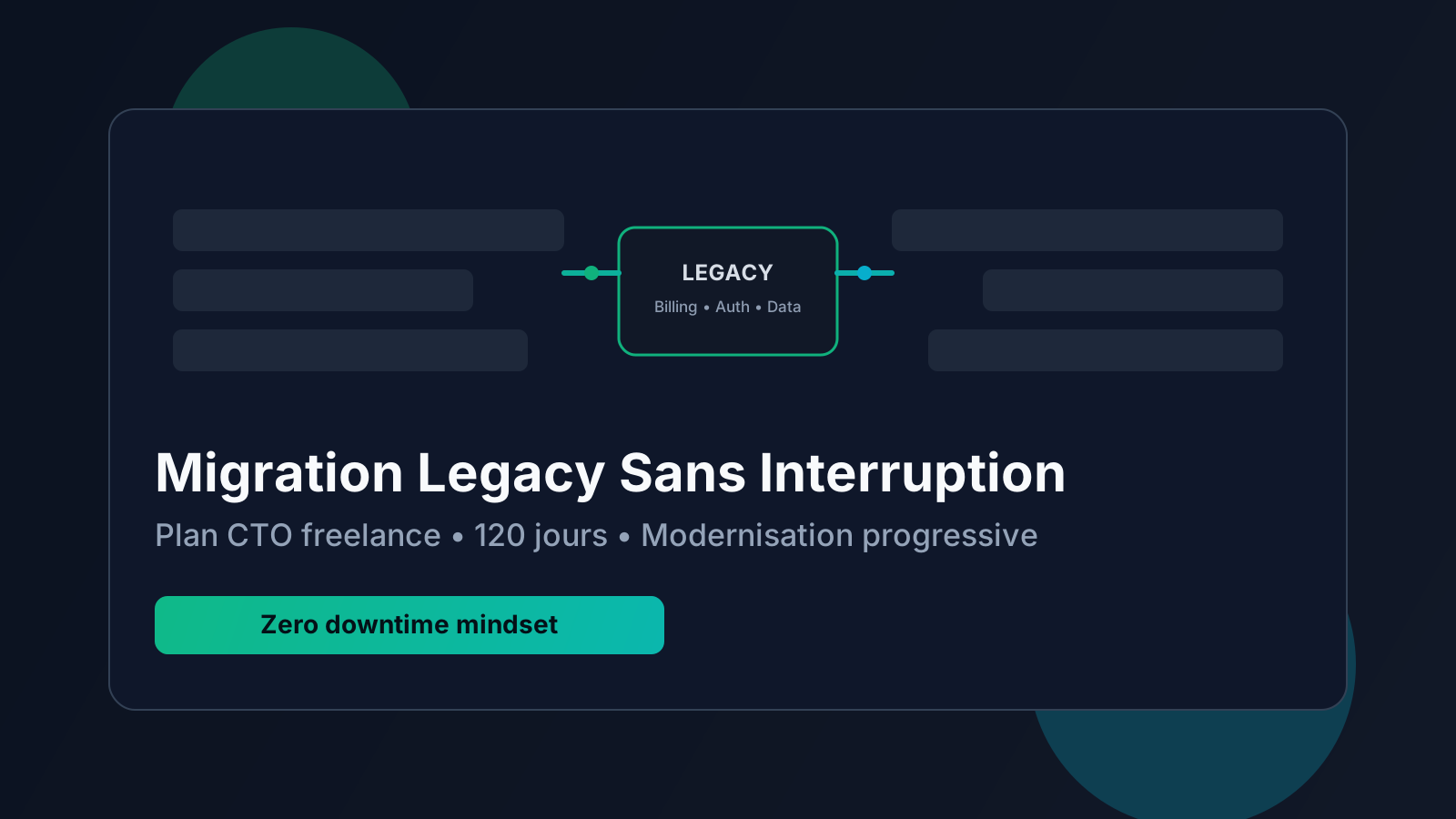
Legacy migration without downtime: a 120-day fractional CTO plan
How to modernize a legacy system without disrupting operations: architecture audit, phased migration strategy, risk governance, and a practical 120-day execution model.