
CTO suddenly left? A 21-day transition plan to stabilize your startup
When a CTO leaves unexpectedly, execution risk rises fast. Here is a practical 21-day transition framework to protect delivery, reduce risk, and regain leadership control.
CTO suddenly left? A 21-day transition plan to stabilize your startup
A CTO departure is one of those moments that exposes how resilient your company really is.
If the transition is weak, problems appear quickly:
- decisions stall,
- roadmap confidence drops,
- production risk increases,
- the engineering team starts operating in uncertainty.
The issue is not only that “a key person left.” The issue is usually a leadership vacuum in technical decision-making.
The good news: you can stabilize the system fast.
This guide gives you a practical 21-day transition framework I use with founders and operators when they need to protect business momentum after a CTO exit.
The real risk is not the departure — it’s the decision vacuum
In early-stage and growth-stage companies, the CTO role is often a critical bridge across:
- architecture direction,
- product/engineering arbitration,
- reliability and incident ownership,
- talent and delivery discipline.
When that bridge disappears, teams can still “ship code,” but alignment degrades.
Common business consequences:
-
Slower and inconsistent decisions
Every architecture or prioritization topic turns into a prolonged discussion. -
Roadmap distortion
Product pushes commitments, engineering sees hidden risks, and no one resolves the trade-offs cleanly. -
Rising operational fragility
Small incidents pile up until a major outage or customer-impacting failure appears. -
Leadership credibility pressure
Board members, enterprise prospects, or investors ask “who owns tech now?” and the answer sounds uncertain.
When to bring in an interim or Fractional CTO
A transition CTO model is usually the right call if at least three are true:
- CTO departure already happened (or is imminent),
- permanent hiring will take 2+ months,
- roadmap pressure is high (fundraising, launch, enterprise deal, migration),
- engineering team lacks stable senior leadership,
- incidents or technical debt were already visible before the departure.
The objective is simple:
restore technical leadership immediately, then prepare the long-term structure.
A practical 21-day CTO transition framework
Days 1–3: secure continuity first
Do not start with reorganizations and strategy decks. Start with continuity and risk containment.
Actions:
- map critical business flows (billing, onboarding, partner integrations, data pipelines),
- verify control of key access (cloud, CI/CD, observability, secrets, domains),
- freeze high-risk production changes temporarily,
- set a temporary decision cell (CEO/COO + Product + technical lead).
Output:
A one-page continuity and risk baseline everyone can align on.
Days 4–7: re-establish decision clarity
The team does not need more meetings. It needs explicit decision ownership.
Actions:
- define decision rights (architecture, debt prioritization, release readiness, incident response),
- restart a weekly product/engineering arbitration ritual,
- define go/no-go production criteria,
- track a minimal KPI set: lead time, P1/P2 incidents, unplanned work ratio.
Outcome:
Fewer unresolved debates, faster execution decisions.
Week 2: roadmap and debt triage by business impact
Many companies try to “speed up” here. Wrong move if the system is still unstable.
Use triage buckets:
- Now: protects revenue, reliability, key customer commitments,
- Next: restores delivery capacity over 4–8 weeks,
- Later: valuable but non-critical.
In parallel, launch 3–5 structural quick wins (examples):
- harden a fragile CI/CD path,
- improve signal quality in monitoring to reduce MTTR,
- remove one obsolete high-risk dependency,
- document incident runbooks for customer-critical flows.
Week 3: execute and prepare the post-transition model
Now you need visible progress and a handoff-ready structure.
Actions:
- deliver validated quick wins,
- publish a weekly scorecard for leadership,
- define target CTO role scope (if hiring),
- define internal growth plan (if promoting a senior lead),
- prepare clean handover documentation (architecture, open risks, decisions log).
Outcome:
The company moves from reactive mode to controlled execution.
What CEOs should demand during the transition
You don’t need to review pull requests. You do need clarity on five questions:
- What are our top three technical business risks right now?
- Which roadmap commitments are truly feasible this quarter?
- How much delivery capacity is consumed by unplanned work?
- What is our 30/60/90-day plan with clear owners and metrics?
- What is the target model: hire a CTO, or strengthen internal leadership?
If these answers are vague, execution risk is still unmanaged.
Mistakes that make the transition worse
1) Waiting for a perfect full-time CTO before restoring leadership
A 3–4 month gap without technical governance is where major drift happens.
2) Founder overcompensation
When founders absorb every technical decision directly, decision quality and team confidence often drop.
3) Starting heavy transformation too early
Immediately launching major rewrites after a departure usually increases risk.
4) Confusing activity with risk reduction
High ticket throughput is irrelevant if critical risks remain unaddressed.
Real-world pattern (anonymized)
B2B SaaS, 11 people in engineering, founder-CTO left with partial handover.
Initial condition:
- recurring incidents in billing integrations,
- roadmap confidence declining,
- unclear ownership for architecture and debt prioritization.
3-week transition intervention:
- access control and critical runbooks secured,
- roadmap triage aligned to revenue and reliability,
- targeted refactor of one unstable service,
- product/engineering arbitration ritual restarted,
- permanent CTO hiring brief prepared with realistic scope.
Six weeks later:
- critical incidents materially reduced,
- more predictable delivery cadence,
- stronger confidence from leadership and board.
Interim CTO vs immediate permanent hiring
This is rarely an either/or decision.
For many startups, the most effective sequence is:
- now: interim/fractional CTO to stabilize and structure,
- next: permanent hiring with a much clearer mandate,
- in parallel: internal leadership development.
This approach protects execution while reducing the risk of a rushed executive hire.
Board-ready operating checklist
If you need a practical leadership tool, use this checklist in your weekly exec review:
- Are critical technical accesses centralized and audited?
- Does each critical business flow have a clear technical owner?
- Are release go/no-go criteria explicit and enforced?
- Are we tracking run-vs-build capacity weekly?
- Are top three technical business risks reviewed at leadership level?
- Is the target leadership model documented (interim + permanent)?
Simple checklists are underrated in transition phases. They reduce ambiguity and keep everyone focused on risk reduction, not noise.
Final takeaway
A CTO departure is a high-risk moment — but also an opportunity to reset priorities, decision systems, and technical governance.
The key is not “replacing the person fast.” The key is restoring reliable technical leadership fast enough to protect the business.
If helpful, I can help you structure a focused 10-day CTO transition sprint:
- continuity and risk diagnosis,
- 30/60/90 priorities,
- product/engineering governance setup,
- target leadership plan (hire vs internal promotion).
Related articles
Technical debt audit for startups: a 30-day remediation plan that protects delivery
How to run a technical debt audit in a startup and execute a 30-day remediation plan without freezing product delivery.
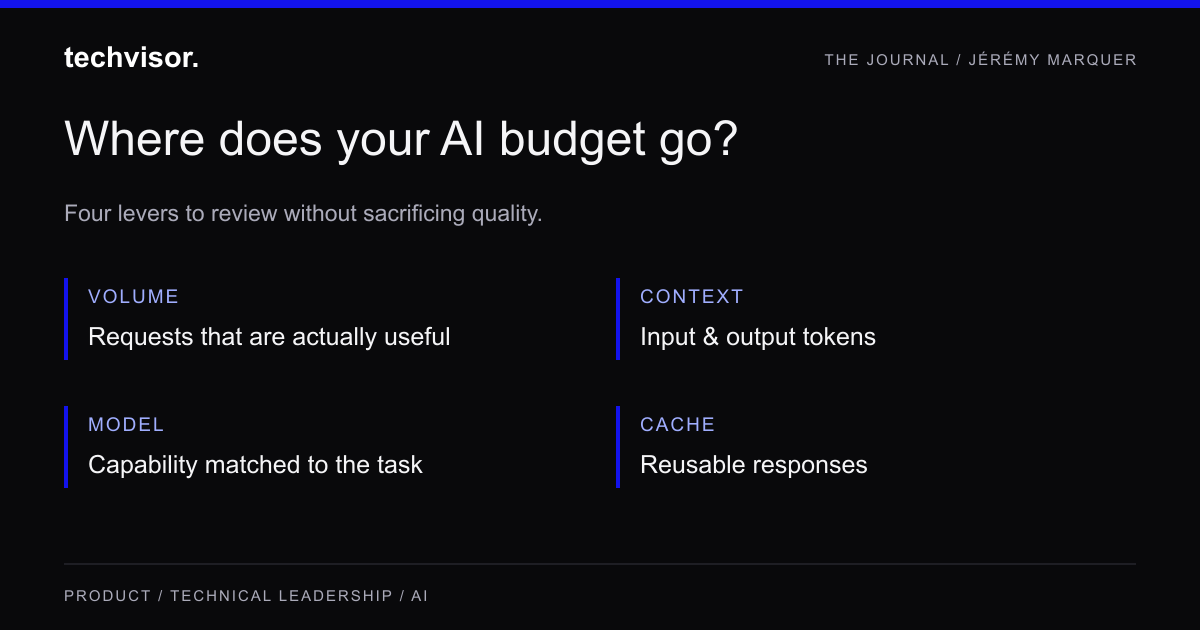
How to reduce LLM costs in a startup: a fractional CTO playbook to cut spend without breaking the product
A practical framework to reduce OpenAI, Anthropic, or Mistral spend in startups through usage audits, prompt trimming, routing, caching, and ROI-based governance.
AI Production Architecture Audit: The 45-Day Plan to Reduce Risk, Cost, and Delivery Chaos
A practical framework for startup and SME leaders to audit AI systems in production: governance, GDPR, reliability, security, and unit economics.